Guadalest Castle (Castillo de San José)
Guadalest Castle: a tower above the void
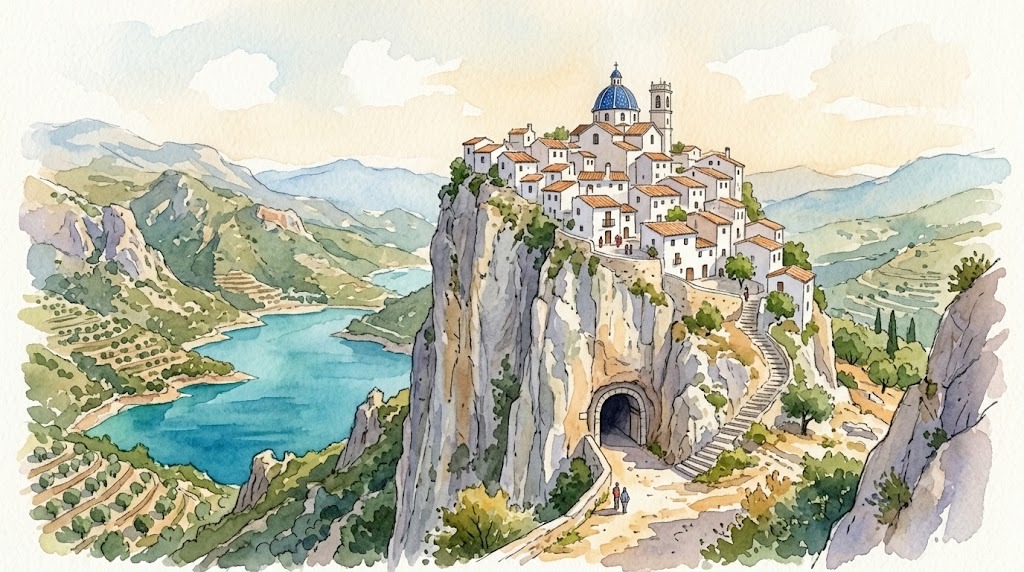
The Castillo de San José occupies the highest point of El Castell de Guadalest, at 595 metres, in a valley ringed by the Xortà, Serrella and Aitana ranges and overlooking the turquoise reservoir that shares its name. Construction began in the 11th century, in Islamic times, and what survives is essentially the keep and remains of wall.
The whole village has been a listed historic site since 1974 and receives around 700,000 visitors a year — the figure given by its mayor for 2024 — with a population of barely 200-odd. It is by far the most visited inland village in Alicante province.
A figure of “two million visits a year” circulates online. It has no institutional backing and contradicts the council’s own data: stick with 700,000.
A history of earthquakes and explosions
- 11th century: construction begins, in Islamic times.
- 1644: an earthquake splits off the Cantalar sector and leaves the belfry cut off from its church.
- 1708: during the War of the Spanish Succession, a mine explosion destroys much of the fortress.
- 1848: the walls are demolished and the garrison evacuated.
The tunnel: the way into the village
The old town is entered through the Portal de San José, a tunnel cut through the rock of the mountain on which the castle stands. It is the image almost everyone remembers of Guadalest. Coming out of the tunnel, the first thing you see is the Casa Orduña, through which the castle is reached.
The tunnel has steps, narrow passages and a sloping threshold: it is not accessible.
The belfry with no church
The most photographed feature in the village is a belfry that does not touch its church. It stands on the Peñón de la Alcalá, a needle-shaped rock that formed part of the castle’s defences, and the rock physically separates it from the church of Nuestra Señora de la Asunción to which it belongs. The documented cause is the 1644 earthquake. The climb is short but steep.
What else to see
- The cemetery, built literally on the edge of the precipice, with graves from the 17th century
- The dungeons, a 12th-century prison on the ground floor of the town hall (Plaza de San Gregorio), with free access
- Alcozaiba castle, whose consolidation works were completed in November 2024
The eight museums
Guadalest has a density of museums that is hard to believe for its size:
| Museum | Price |
|---|---|
| Casa Orduña (17th century, includes castle access) | ~€4 |
| Microgiant Museum | ~€5 |
| Microminiatures Museum | ~€5 (combined with the above) |
| Ethnological Museum | Free |
| Nativity Scenes and Dolls’ Houses (Antonio Marco) | — |
| Historic Vehicle Collection | — |
| Medieval History Museum | — |
| Salt and Pepper Shaker Museum | — |
The Casa Orduña deserves attention beyond being the obligatory way to the castle: it preserves the kitchen, the dining room with its ceramics collection, the bedrooms, the Arches room, a map room with plates printed in Paris in 1706 and a library of 1,265 volumes catalogued between 1500 and 1800.
The Microgiant and Microminiatures museums are the local curiosity: a bullring on a pinhead, the Bible written on a human hair, a dressed flea on a bicycle, a self-portrait carved on a grain of sand.
Hours and prices: why you should phone
Here we have to be transparent. The council’s official website publishes neither hours nor prices for its monuments and museums: it refers you to 965 88 50 95 or secretaria@guadalest.es.
Secondary sources contradict each other: some give 10:00-19:00 daily, others 10:15-19:00 in high season and 10:15-18:00 in low with a 14:00-15:00 closure on Thursdays and Sundays, and others summer 10:00-20:00 and winter 10:00-18:00. The combined ticket is around €4 (€2 children).
Count on 10:00 to 19:00, until 18:00 in winter, and confirm by phone if you are coming a long way or on a tight schedule.
Tourist office: Avenida Alicante s/n, in the car park itself. Tel. 965 885 298. Hours: Mon-Fri 9:00-15:00; Sundays 10:00-14:00; closed Saturdays (open 10:00-14:00 on the last Saturday of the month, closed on the last Sunday).
Getting there and parking
By car, following the council’s own routes:
- From Benidorm: CV-70
- From Altea: CV-755
- From Alcoi and Cocentaina: CV-70
By bus: line 016 of Llorente Bus (Grupo Avanza) connects Cala Finestrat and Benidorm with Guadalest via La Nucía and Polop. Some 55 stops and around 58 minutes for the full route, with a daily service, and the Guadalest stop is “V. Aparcamiento Guadalest”: it stops right at the car park. There is no direct service from Alicante: combine TRAM L1 to Benidorm and take the 016 there.
Parking: the old town is pedestrian. There are three regulated municipal car parks at the village entrance, on the CV-755, next to the tourist office (where the toilets also are), at a flat rate of about €2 for the whole day, with an attendant. Some sources say they are free in low season: check the signage. When they fill up — from mid-morning in high season — there is a free lower area about 15 minutes’ walk uphill.
Best time to go
Before 11:00 or late afternoon. It is the most crowded village in inland Alicante and the excursion coaches from Benidorm arrive mid-morning. Spring and autumn are the best seasons; avoid midday in July and August, and long weekends.
What’s coming
The council has a planned pedestrian path from the castle to the Mas de la Mona, due to be built before 2027, plus work on the CV-755 to remove a problematic traffic light and restore both lanes. In 2024 the village marked two anniversaries: 30 years since the municipal acquisition of the Casa Orduña and 50 years since its listing as a historic site.
Practical information
| Altitude | 595 m |
| Origin | 11th century, Islamic period |
| Village | Listed historic site since 1974 |
| Ticket | ~€4 general / €2 children (with Casa Orduña) |
| Hours | Approx. 10:00-19:00 (18:00 in winter) — confirm on 965 88 50 95 |
| Access | Portal de San José tunnel, with steps |
| Accessibility | Not accessible |
| Parking | 3 municipal on the CV-755, ~€2/day |
| Bus | Line 016 from Benidorm (~58 min) |
| Visitors | Around 700,000 a year (2024) |
What’s nearby
- The Guadalest reservoir, with roadside viewpoints
- The historic centre of Guadalest
- The Fonts de l’Algar in Callosa d’en Sarrià, about 15 minutes away
- The Puig Campana and the Serra Gelada
- Towards the coast: the beaches and coves of Altea and Benidorm
Frequently asked questions
How much is Guadalest castle and when does it open?
The combined Casa Orduña + Castillo de San José ticket costs around €4 general and €2 for children, and the castle is entered through the Casa Orduña. On hours we have to be honest: the council's official website publishes neither hours nor prices, and secondary sources contradict each other (10:00-19:00, 10:15-19:00, until 20:00 in summer, with a possible 14:00-15:00 closure on Thursdays and Sundays). Count on 10:00 to 19:00, until 18:00 in winter, and confirm on 965 88 50 95.
Can you drive into the old town?
No: the historic centre is entirely pedestrian and the upper part is reached only on foot, through the tunnel. There are three regulated municipal car parks at the village entrance, on the CV-755 next to the tourist office, at a flat rate of about €2 a day (some sources say they are free in low season; check the signage). When they fill up, there is a free lower area about 15 minutes' walk uphill.
Why is the belfry separate from the church?
Because the rock physically separates them: the belfry stands on the Peñón de la Alcalá and the church of Nuestra Señora de la Asunción, to which it belongs, ended up on the other side. The documented cause is the 1644 earthquake. It is the most photographed feature in the village.
Is the castle accessible?
No. You can reach the base of the rock formation without difficulty, but the climb to the tower is not accessible. The Portal de San José — the tunnel — has steps, narrow passages and a sloping threshold, and the old town streets are cobbled and uneven.
How do you get there from Benidorm?
By car on the CV-70 (from Altea, the CV-755). By bus, line 016 of Llorente Bus (Grupo Avanza) connects Benidorm with Guadalest via La Nucía and Polop: some 55 stops and around 58 minutes for the full route, stopping right at "V. Aparcamiento Guadalest". There is no direct service from Alicante: you change at Benidorm.