Altea Old Town
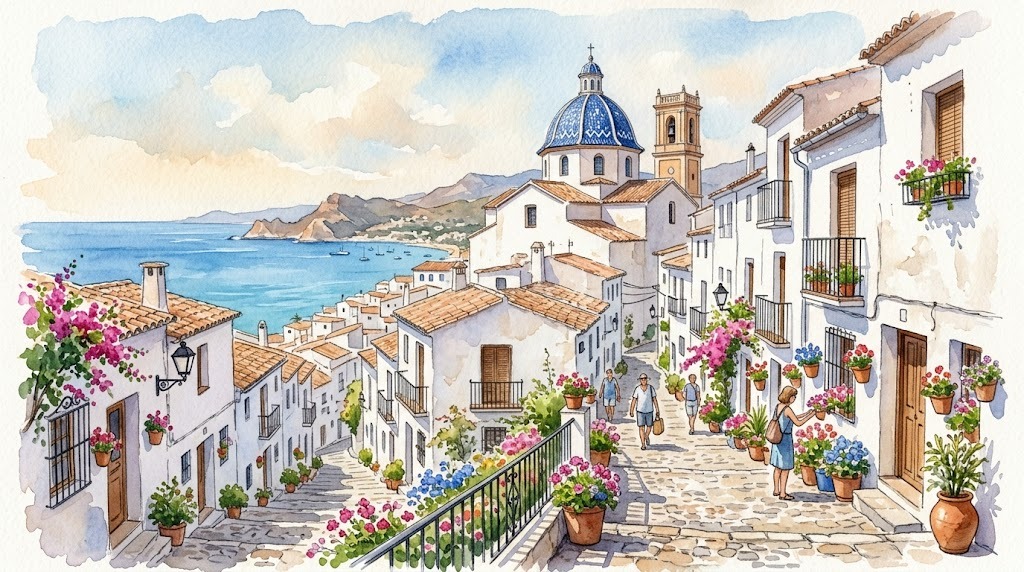
Altea old town: a Renaissance enclosure above the bay
Altea has the most photographed old town on the Costa Blanca, and for good reason: a fortified Renaissance enclosure on top of a hill, whitewashed houses, cobbled streets climbing steeply and, crowning it all, the church of the Mare de Déu del Consol with its two domes of blue-and-white ceramic tile. The regional tourist board calls it “the dome of the Mediterranean”.
What almost no guide tells you is the practical part: that you cannot drive up, that there are two large free car parks below, and that on Tuesday mornings the market takes them over. Let’s start there.
Getting there and where to park
The enclosure is pedestrian. The nearest car park you can drive to is on carrer Sant Xotxim, right at the foot of the climb, but it has few spaces and in high season parking is very difficult. The two realistic alternatives are free and large:
- La Basseta car park — the most used, about 10-15 minutes’ climb away.
- Camí de l’Algar (the Algar river) — further out (around 15 minutes), but almost always has space.
The car parks at Bellas Artes, Piteres, the TRAM station and Avenida La Nucía (Foietes) are also free. Paid options: one on carrer Ponent, the closest to the old town, and another behind the town hall.
The Tuesday warning. The weekly market occupies La Basseta and Foietes from 8:00 to 14:00. If you are driving on a Tuesday morning, head straight for Camí de l’Algar or come by train.
By TRAM: line 9 (Benidorm–Dénia) has four stops within Altea: Altea, Garganes, Cap Negret and L’Olla. Roughly one train an hour; 15 minutes from Benidorm. Check current timetables at tramalacant.es, as they change often.
Local bus: in summer the council usually runs a circular route connecting the outlying car parks with a stop in the old town (every 30 minutes, roughly 12:30 to 00:30). It is the only way to avoid the climb, but confirm it is operating at Tourist Info: it began as a pilot scheme and no stable calendar is published.
Taxi: Radio Taxi Marina Baixa, 966 81 00 10.
What exactly you are visiting
The complex is listed as a Bien de Interés Cultural in the Historic Site category by Decree 69/2013 of the regional government (published in the state gazette on 1 July 2013), under the name “Bastion and Renaissance Enclosure of the Town of Altea”.
It is a purpose-built Renaissance enclosure, quadrangular in plan and oriented northeast-southwest, with ashlar walls at the corners. It has one historical peculiarity that sets it apart from almost every other Valencian coastal fortification built against Barbary piracy: the lord of Altea paid for it, not the Crown.
There are two gates: the Portal Vell, to the north, which opened onto the royal road, and the Portal Nou, to the east, from the 18th century.
The protecting decree also explains why the town looks the way it does: it prohibits exterior advertising, setbacks and courtyards on the façade, any blinds that are not traditional, changes to the historic plot pattern and any roof that is not double-pitched with curved tile. And it requires wooden joinery and lime mortar or whitewashed render.
The church with the blue domes
The church of the Mare de Déu del Consol you see today is not the original. The first church was built between 1607 and 1617 (architects Pere and Damià de la Càmara) and became a parish in 1640. The present building dates from 1901-1910, by Adrián and Julio Vela Gadea, and was consecrated on 18 September 1910.
Latin-cross plan of the Jesuit type, described as neo-baroque by the regional tourist board, and two bell towers on the façade, the left one taller. What made it famous are the two domes clad in glazed blue-and-white ceramic tile laid like scales. It has been protected as a Bien de Relevancia Local since 2007 and was restored between 1980 and 1989.
Free entry. The parish publishes no public opening hours: it opens around mass times. In the autumn-winter season, Tuesday, Wednesday, Friday and Saturday at 18:30; Sundays and public holidays at 9:00 and 12:00.
The viewpoints
The main one is the Mirador dels Cronistes (of the Chroniclers of Spain), on the church square itself, on top of the wall: views over Altea bay, l’Albir, the Serra Gelada, Benidorm and, on clear days, as far as the Penyal d’Ifac. Free access, no opening hours.
There are two more nearby: the Glorieta del Maño and the area around the Torre de Bellaguarda.
What to see inside the enclosure
- The Portal Vell and the start of carrer Major, the axis linking the gate to the church square
- The church square, with the church and the viewpoint
- The Portal Nou (18th century)
- Calle Salamanca, with 18th and 19th-century houses
- The streets Santa Bárbara, Honda and Concepción, and the remains of wall and bastion
Best time to visit
Sunset, without question: the domes and the bay seen from the viewpoint with the western light falling on the Serra Gelada. In July and August, the alternative is first thing in the morning: by afternoon the town is packed and there is no shade on the slopes. From October to May it is practically empty.
Practical information
| Location | Altea (Marina Baixa), above the bay |
| Protection | Listed Historic Site (Decree 69/2013) |
| Access | Pedestrian; 10-15 min climb from the car parks |
| Parking | La Basseta and Camí de l’Algar, free |
| Church | Free entry; no fixed public hours |
| Viewpoints | Dels Cronistes, Glorieta del Maño, Torre de Bellaguarda |
| Accessibility | Poor: cobbles, gradient and steps |
| Best time | Sunset; early morning in summer |
| Tourist Info | C/ Sant Pere, 14 · 96 584 41 14 |
What’s nearby
- Platja de l’Olla, with its islet and the August Castell de l’Olla fireworks
- The full guide to Altea beaches and coves: nine pebble beaches with crystal-clear water
- Palau Altea (arts centre), the Sant Pere promenade and the harbour, minutes away
- The Altea guide for the rest of the town
Discover more about
Altea
Altea: the most photographed old town on the Costa Blanca, with its blue-domed church, and 9 beaches without a single metre of sand. Pedestrian old quarter, where to actually park, and the real fiesta calendar.
Frequently asked questions
Can you drive up to Altea's old town?
No. The enclosure is entirely pedestrian, with cobbled streets on a steep slope. You leave the car below and walk up. The closest car park you can drive to is on carrer Sant Xotxim, at the foot of the climb, but it has few spaces and fills up in summer.
Where can you park for free in Altea?
The two big free car parks are La Basseta and Camí de l'Algar (by the Algar river), about 10-15 minutes' walk from the old town. Bellas Artes, Piteres, the TRAM station and Avenida La Nucía are free too. Watch out on Tuesdays: the weekly market takes over La Basseta and Foietes from 8:00 to 14:00.
How long is the walk up to the church?
From La Basseta or Foietes, allow 10-15 minutes of continuous climbing to the church square; from the TRAM station, 20-25. That is our own estimate: the gradient is constant and the cobbles uneven.
Can you go inside the church with the blue domes?
Entry is free, but the parish publishes no opening hours: in practice it opens around mass times (Tuesday, Wednesday, Friday and Saturday at 18:30; Sundays at 9:00 and 12:00 in the autumn-winter season). If you want to see the interior, ask at Tourist Info Altea (96 584 41 14).
Is the old town wheelchair accessible?
No. The streets are cobbled, steeply sloping and include flights of steps. In summer the town council usually runs a circular bus route linking the car parks with a stop in the old town, which avoids the climb; worth confirming it is running at Tourist Info.
📖 Guides to Altea
- Altea Beaches and Coves: Complete Guide 2026 The 9 beaches and coves of Altea north to south, from Mascarat to Cap Blanc: pebbles, transparent water and the best shore snorkelling in the Marina Baixa. Access, parking, facilities and the dog-friendly area at l'Olla.