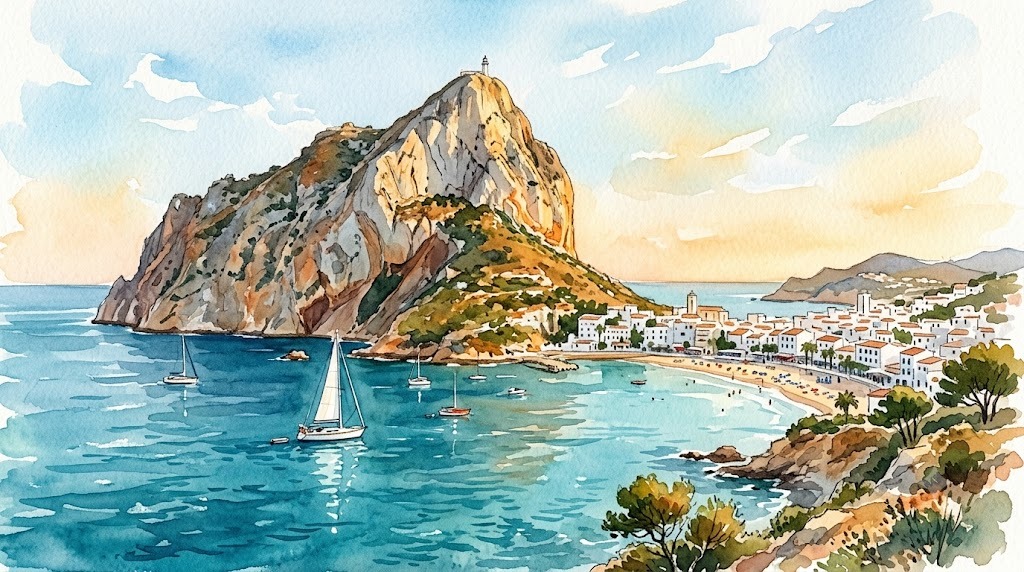
Les Salines de Calp
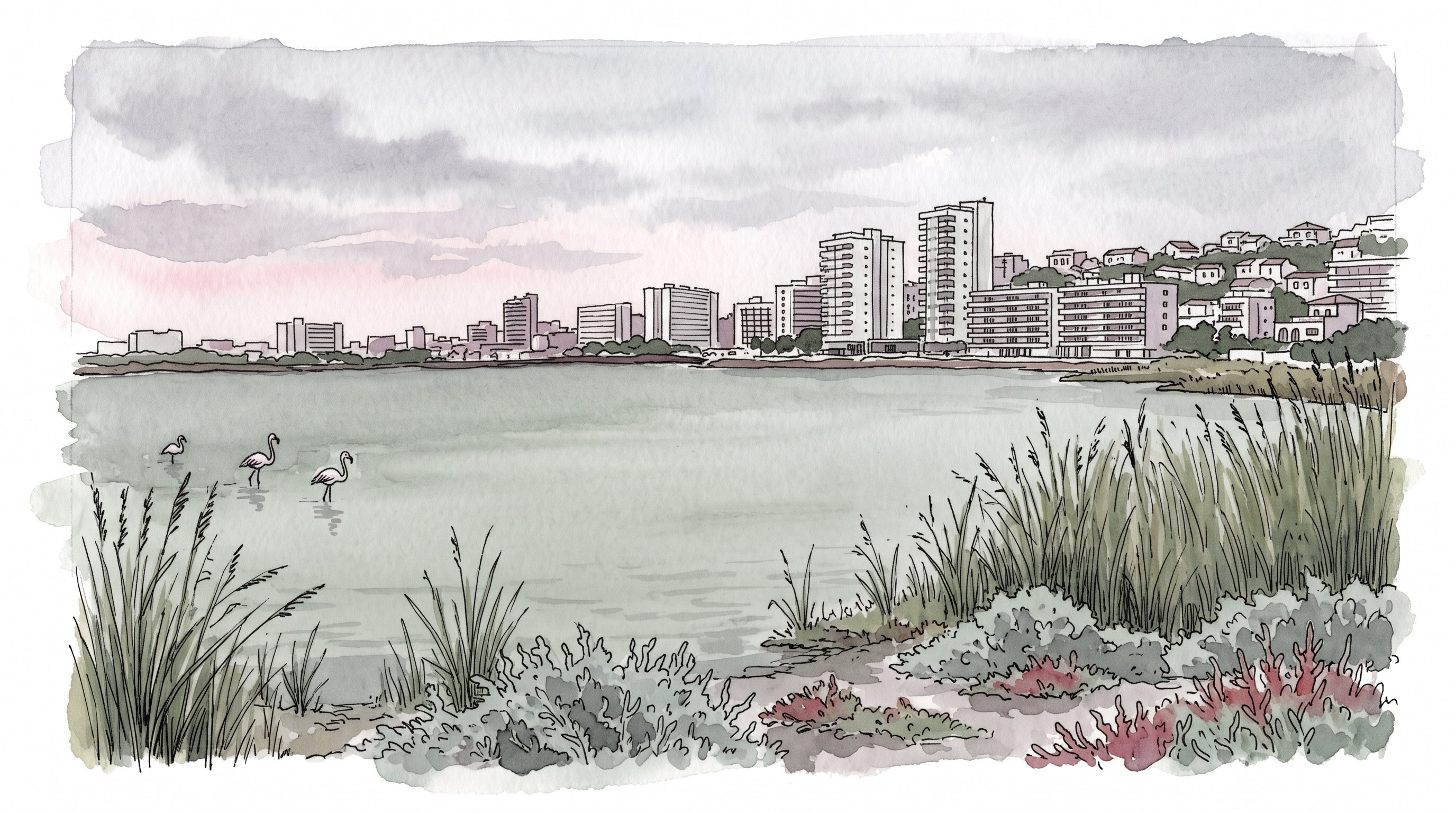
Les Salines de Calp: flamingos at street level
There are few places where you can watch flamingos with a 332-metre rock behind them and a supermarket at your back. Les Salines de Calp are exactly that: a 41.08-hectare wetland in the middle of town, about 500 metres from the Penyal d’Ifac, still working as a bird refuge even though it stopped producing salt almost forty years ago.
Its origin is geological: a coastal lagoon of tombolo origin, formed by the double line of sand bars that eventually joined the Penyal to the mainland. It is catalogued as a coastal saltmarsh in the Catalogue of Wetlands of the Valencian Community and was declared a maritime-terrestrial zone in 1993.
Two thousand years of salt
The lagoon was probably turned into a salt pan as early as Roman times: seawater entered through channels and sluices driven by the waves. That salt was used to preserve fish and to produce garum, the fermented fish sauce made at Calp’s Baños de la Reina. Its heyday came in the 2nd century AD.
Then came abandonment. In the 18th century, as the lagoon lost salinity, its elimination was actually ordered — in 1786 — for fear of malaria. Modern exploitation rebuilt it in the 20th century, driven by Vicente Buigues, “Ti Marguí”, and it came to supply salt to more than 40 municipalities. Production ceased for good in 1988.
The birds: what you see and when
173 species have been recorded. The star is the greater flamingo (Phoenicopterus roseus), present much of the year and with populations of several hundred birds at peak. The best months are May, June, July and August.
An honest warning: this is not a breeding colony. Only one nesting attempt is documented, in the summer of 2002, and numbers fluctuate a great deal. Anyone coming expecting flamingo chicks will be disappointed.
Alongside the flamingos: black-winged stilt (Himantopus himantopus), grey heron, Kentish plover, water rail, common coot, and vulnerable species such as the marbled teal and the white-headed duck.
A note on its protection. Les Salines are in the Catalogue of Wetlands of the Valencian Community and are maintained by Calp town council, but they are not part of the Natura 2000 network, contrary to what some sites claim. What is a Special Protection Area and Site of Community Importance is the adjoining Penyal d’Ifac Natural Park.
The path and the hides
The outer perimeter path is free and open all year: flat, with no gradient, uniform non-slip paving, suitable for wheelchairs and pushchairs, with interpretive panels at the start (Roman history and ecological value) and benches with backrests and armrests.
Sources disagree on the length: the accessible-tourism audit measures 2.3 km for the accessible circuit from the Peñón Tourist Office, and other sources give 3.9 km for the full loop. Allow between 45 minutes and an hour and a half depending on the route and your pace.
There is also an inner path leading to several bird hides, one of them wooden, built to allow observation without disturbing the wildlife. That route is not accessible for reduced mobility.
Documented weak point: on Avenida Polonia the pavement narrows to 100 cm and vegetation encroaches on the way through.
Getting there and parking
By car: AP-7 exit 64 (Altea/Calpe), then the N-332 and follow signs for “Port” or “Penyal d’Ifac”: the salt flats are on the way.
Parking: there is a large free gravel area next to the salt flats, widely used as an alternative to the Penyal car park — which is tiny and always full — and to the paid parking by the harbour. From there it is about 10 minutes on foot to the start of the climb up the Peñón. There are 2 reserved spaces for people with reduced mobility at the Peñón Tourist Office, the starting point of the accessible route.
By TRAM: line 9 has a station in Calp. Benidorm-Calp takes 36 minutes; Dénia-Calp about 45. Hourly service.
Tourist Info Calpe Salinas: Avenida de los Ejércitos Españoles, 44.
Best time of day and year
For flamingos, May to August. For light and bird activity, early morning and late afternoon; sunset with the Penyal silhouetted behind is the photographic moment. Midday in summer is hard going: there is no shade and the glare off the salt is tiring.
A project under way
In November 2025 the council brought Les Salines into the “Alicante Renace” project, designating a first site of almost one hectare. On the first planting day 200 trees were planted by 200 volunteers, with protected species such as tetraclinis (Tetraclinis articulata), rosemary and carob, to restore 10,000 m² of wetland.
Practical information
| Area | 41.08 ha |
| Protection | Valencian Community Wetlands Catalogue (coastal saltmarsh) |
| Price | Free, no booking |
| Outer path | Open all year, flat and accessible |
| Inner path | To the hides; not accessible |
| Length | 2.3-3.9 km depending on route (45 min - 1 h 30) |
| Flamingos | May to August; not a breeding site |
| Species recorded | 173 |
| Parking | Free gravel area next to the salt flats |
| Distance to the Penyal | About 500 m |
What’s nearby
- The Penyal d’Ifac, 500 metres away — remember it requires advance booking and limits access to 300 people a day
- The Baños de la Reina, the Roman garum works that used this salt
- Calp’s fishing harbour and fish market
- The beaches and coves of Calp: 14 of them, from La Fossa to the Morro de Toix
- The Calp guide
Discover more about
Calpe
Calp: the Peñón de Ifach (332 m, with compulsory advance booking capped at 300 places a day), 14 beaches and coves, the Salines wetland with flamingos in the middle of town, and the October Moors and Christians.
Frequently asked questions
When can you see flamingos at the Calp salt flats?
The best months are May, June, July and August, with populations of several hundred birds. They are present much of the year, but numbers fluctuate a great deal. It is not a breeding colony: only one nesting attempt has been documented, in the summer of 2002.
Can you go inside the salt flats?
You can walk the outer perimeter path, free and open all year, and there is an inner path leading to several bird hides, one of them wooden. What you cannot do is walk freely across the ponds.
Is it wheelchair accessible?
The outer path is: flat, with no gradient, uniform non-slip paving, interpretive panels and benches with backrests and armrests. The inner path to the hides is not. One documented weak point: on Avenida Polonia the pavement narrows to 100 cm and vegetation encroaches.
How long does the circuit take?
It depends on the route: the accessible-tourism audit measures 2.3 km for the accessible circuit from the Peñón Tourist Office, while other sources give 3.9 km for the full loop. Allow between 45 minutes and an hour and a half.
Do you have to pay or book?
No: it is free with no capacity limit. Careful not to confuse it with the Penyal d'Ifac, 500 metres away, which does require advance booking, with a limit of 300 people a day.
📖 Guides to Calpe
- Calp Beaches and Coves: Complete Guide 2026 The 14 beaches and coves of Calp north to south, from the Penyal d'Ifac to the Morro de Toix: La Fossa, Arenal-Bol and Cantal Roig (Blue Flags), Les Urques (the only dog-friendly one) and the unspoilt southern coves. Includes the 2026 Penyal booking rules.