Xaló
Xaló: a village that emptied and filled again
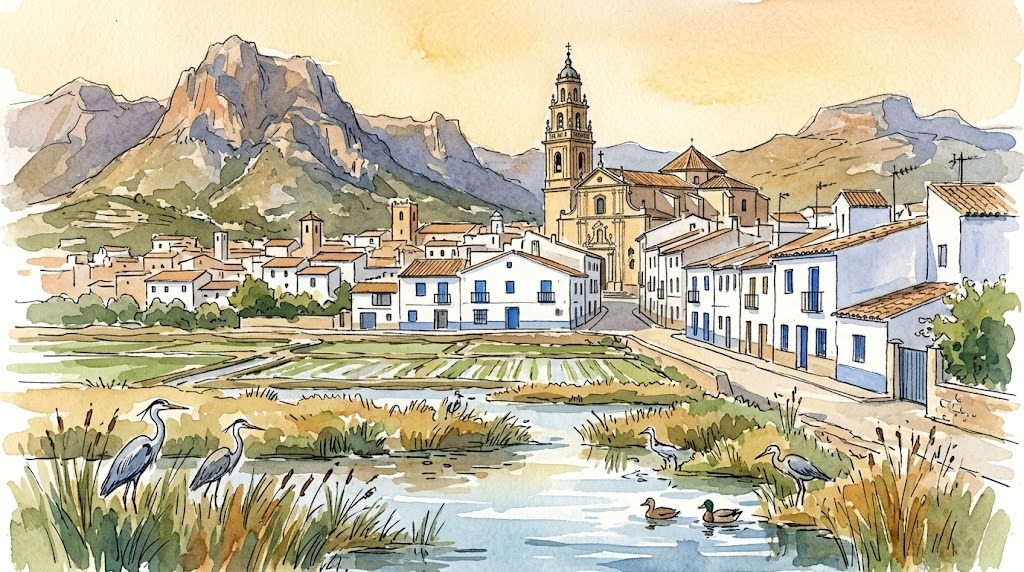
Xaló has 3,104 inhabitants (INE, 2025) across 34.59 km² of valley, inland, half an hour from the coast. It is one of those villages people drive through “on the way to the beach” and which in fact explains the comarca better than Dénia or Calpe do.
Because something happened to Xaló that happens to almost no village: it was emptied. And what is here today — the moscatel, the riuraus, the mistela, the August fiesta, a good share of the surnames — comes from how it was filled again.
The date that explains everything: 1609
The valley had more than five hundred years of Muslim population, from the 8th century, organised into alquerías — small farming settlements — with their own hydraulic system. When James I conquered these lands around 1244, the mudéjares stayed: they went on farming the valley under Christian rule for almost four more centuries.
That ended in 1609, when the Duke of Lerma decreed the expulsion of the moriscos. Xaló was left almost depopulated.
And here is what makes the village singular: in 1611, barely two years later, 36 families from Mallorca and Ibiza signed the Carta Pobla and settled in the valley. The settlers of the Ràfol de Xaló came in good part from Santa Margalida, in Mallorca — which is why Xaló is still twinned with Santa Margalida (and with San Juan, in Argentina, through later emigration).
That is why the Vall de Pop preserves Balearic customs and traditions you will not find on the coast twenty kilometres away. It is not reinvented folklore: the people came from there.
The moscatel and the riuraus
The second layer of Xaló’s identity is economic, and it also has dates.
Until the early 19th century the valley was subsistence farming. From around 1818 raisin production became dominant, and by 1853 municipal records already noted that vineyards occupied the greater part of the municipal area. The grape was moscatel, and the raisin trade connected Xaló directly to the ports of Dénia and Xàbia, from where it was exported to Europe.
What remains of that cycle is the architecture that defines the landscape: the riuraus, rural buildings with an open arcaded gallery, where the grapes laid out to dry were pulled in when rain threatened. A riurau is not a decorative porch: it is a production tool, and its size depended on the harvest that had to be protected.
When the raisin business collapsed, the moscatel stayed — but as wine and as mistela, the sweet liqueur of the comarca. The cooperative is still the village’s economic centre, and the Wine Fair in May is its shop window.
The Vall de Pop, and one precision
Xaló sits in the Vall de Pop, and it is worth being exact about what that means, because it is used two ways:
- The historic Vall de Pop is three municipalities: Benigembla, Murla and Parcent. The name comes from the Cavall Verd mountain, also called “muntanya de Pop”.
- The Mancomunitat Intermunicipal de la Vall de Pop, created in 1991, today groups eight municipalities, some 21,000 inhabitants and 227.40 km² — and it is in this broader sense that Xaló is included.
What unites the valley geographically is the Xaló-Gorgos river: a 283.2 km² basin and some 50 km of course before it reaches the sea at Xàbia, designated a Site of Community Importance in 2005. That river is the thread connecting the inland moscatel to the coastal ports, and it is no accident that the raisin trade followed its course.
What to see
- The church of Santa María, completed in 1831 and built at the expense of the Duchess of Almodóvar
- The old quarter, whose oldest part preserves the irregular layout and narrow streets of the Moorish period — you notice it as you walk
- The riuraus scattered across the municipality
- The Castell d’Aixa, in the range that closes the valley
Fiestas: the real calendar
| Fiesta | When (2026) |
|---|---|
| Wine Fair | 22-24 May |
| Festes d’Agost: Sant Domènec | 1-10 August, main day the 4th |
| Festa del Moscatell | 19-20 September |
| Mare de Déu Pobra | 19 October |
The big ones are the Festes d’Agost in honour of Sant Domènec, with the main day on 4 August: some ten days of floats, Nit de Rock, Dia de la Paella and bous al carrer.
And two fiestas tell the village’s identity better than any other: the Wine Fair in May and the Festa del Moscatell in September, coinciding with the harvest. If you are coming for the wine, those are the dates.
A Festa del Romer is also held in spring, for which we have no confirmed programme: check with the council before planning around it.
Getting there
- By car: from the coast, the CV-750 from Gata de Gorgos, or the CV-745 from Benissa. Half an hour from Dénia or Xàbia
- By TRAM: it does not reach here. The nearest line 9 stop is Gata de Gorgos, and from there you need a car or a taxi
- By bus: a low-frequency comarcal service to Dénia and Gata
This is an inland village in a valley: without a car the visit is awkward, and it is worth combining with the neighbouring villages of the valley on the same trip.
When to come
- May: the Wine Fair, and the valley at its best before the heat
- Early August: the Festes d’Agost, if you want a real village fiesta
- September: harvest and the Festa del Moscatell — for my money, the best time
- Autumn and winter: the valley is empty and the paths walk well; many restaurants cut their hours
What’s nearby
- The villages of the valley: Parcent, Murla, Alcalalí, Llíber and Benigembla — pages in Spanish for now
- To the east, Gata de Gorgos and the way out to the coast
- To the south, Benissa; to the north, Pego and Orba